The Studio That Was Fully Booked but Still Struggling Financially
Sunrise Collective, a boutique yoga studio in a mid-sized suburban market, had every surface-level indicator of success. Classes were full, instructors were talented, and client satisfaction scores were high. Yet the owner, Maya, was watching her monthly revenue plateau despite a waitlist of prospective members sitting untouched in her inbox. Learn more about fitness studio customer story campaigns.
The core problem was not demand — it was conversion. Maya was spending money on Instagram ads and occasional email blasts, but none of it was converting cold prospects into paying members at a meaningful rate. The people who did join almost always cited a personal recommendation or a friend’s success story as the deciding factor. That insight became the foundation of everything that followed. Learn more about user-generated content for small businesses.
After a discovery audit, it became clear that Sunrise Collective was sitting on a goldmine of untapped social proof. Over three years of operation, Maya had accumulated dozens of genuine client transformation stories — weight loss journeys, anxiety recovery, post-surgery rehabilitation, and profound mindset shifts. None of these stories had ever been formally captured, structured, or deployed as marketing assets. They existed only in passing conversations and the occasional heartfelt comment on a class check-in sheet. Learn more about testimonial types that boost conversions.
The strategy that reversed Maya’s revenue plateau did not involve a bigger ad budget or a new service offering. It involved building a systematic lead generation funnel entirely around the authentic transformation stories her clients had already lived. Within four months, monthly revenue climbed 43%, and the studio’s email list grew from 312 subscribers to over 1,100 active contacts. Learn more about video testimonial format performance data.
Step One: Mining and Structuring the Transformation Stories
The first phase of the project focused entirely on story collection and architecture. Maya identified twelve clients who had experienced measurable, meaningful changes through their yoga practice. She personally reached out to each one with a simple, low-pressure request: a thirty-minute recorded conversation about their experience. The response rate was eleven out of twelve, which confirmed what Maya already suspected — her clients were proud of their progress and happy to share it when asked directly. Learn more about turning customer stories into leads.
Each recorded conversation was then transcribed and structured using a proven narrative framework: the Before State, the Turning Point, the Journey, and the After State. This four-part structure did two critical things simultaneously. It made each story emotionally compelling for a reader or viewer, and it naturally addressed the primary objections that prospective clients carry — fear of not being fit enough, uncertainty about whether yoga could address their specific issue, and skepticism about results being real rather than exaggerated.
From each structured story, the team produced four distinct content assets: a long-form written case study of approximately 800 words, a short-form social media caption series of three posts, a two-minute video testimonial using the client’s own recorded audio paired with still photography, and a pull quote graphic formatted for Instagram and Pinterest. This meant twelve client stories generated 48 unique content assets ready for deployment across the funnel without any additional creative work beyond the initial conversation.
One critical detail separated this approach from ordinary testimonial collection: every story was approved by the client before publication, and each client received a small token of appreciation — a complimentary private session. This created goodwill, ensured accuracy, and turned the storytelling clients into enthusiastic promoters who organically shared their own case study with their personal networks. The referral spike alone accounted for six new memberships in the first sixty days.
Step Two: Building the Funnel Around the Stories
With the content assets ready, the next phase was engineering the actual lead generation funnel. The architecture was deliberately simple: a targeted Facebook and Instagram ad campaign drove cold traffic to a dedicated landing page, which offered a free downloadable guide titled “5 Real Women Who Transformed Their Health Through Yoga.” The guide contained five of the twelve case studies in a beautifully formatted PDF, and accessing it required only a first name and email address.
The landing page itself was built around social proof rather than promotional language. Instead of listing class schedules and membership tiers, it featured three pull quotes from transformation stories above the opt-in form, a short paragraph of context from Maya written in first person, and a single clear call to action. The page had no navigation menu, no links to other pages, and no distractions. Its only job was to collect an email address in exchange for the guide.
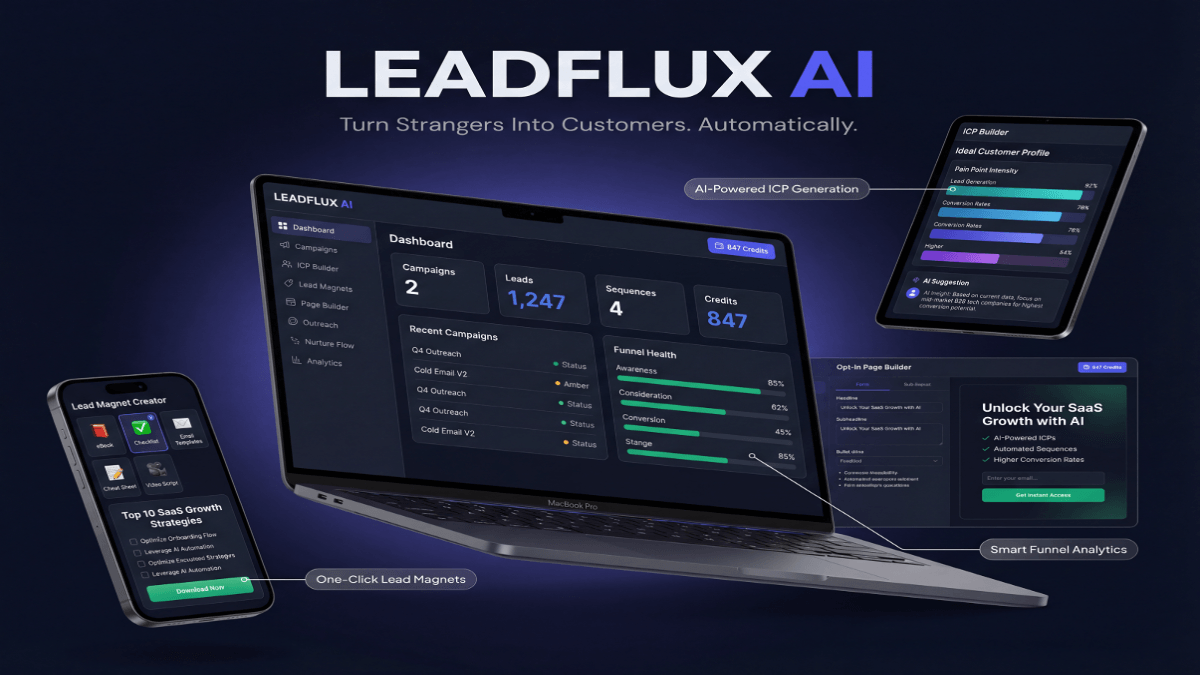
Stop Guessing. Start Converting.
LeadFlux AI Does the Heavy Lifting.
Tracking KPIs is only half the battle — you need a system that turns data into revenue. LeadFlux AI automatically identifies your highest-value prospects, scores leads in real time, and delivers conversion-ready pipelines so you can focus on closing deals, not chasing dead ends.
See How LeadFlux AI WorksOnce a prospect opted in, they entered a seven-email nurture sequence delivered over fourteen days. Each email featured one additional transformation story along with a specific, actionable tip related to that client’s journey — for example, the email accompanying a stress-recovery story included a short breathwork exercise the reader could try immediately. This approach positioned Sunrise Collective as a genuinely helpful resource rather than a business chasing a sale, which dramatically increased open rates. The sequence averaged a 47% open rate across all seven emails, well above the industry standard for fitness and wellness businesses.
The seventh and final email in the sequence made the offer: a complimentary two-week trial membership with no commitment required. Because prospects had spent two weeks receiving real value and reading relatable transformation stories, the trial offer felt like a natural next step rather than a hard sell. Of the leads who completed the full seven-email sequence, 31% converted to a trial membership — and of those trial members, 68% converted to a paid monthly membership within the following thirty days.
The Numbers Behind the 43% Revenue Increase
- Story Collection Phase (Weeks 1–2): Twelve client interviews conducted, transcribed, and structured. Zero paid media spend. Total time investment from Maya: approximately eight hours of personal outreach and conversation.
- Content Production Phase (Weeks 2–4): 48 content assets produced from twelve stories, including written case studies, video testimonials, social captions, and quote graphics. Production was handled by a part-time freelance designer and video editor at a combined cost of $1,200.
- Funnel Build Phase (Week 4): Landing page, lead magnet PDF, and seven-email nurture sequence built and tested. Email platform cost was absorbed into an existing subscription. Landing page was built using the studio’s current website platform at no additional cost.
- Paid Amplification (Months 1–4): Facebook and Instagram ad spend totaled $780 per month, targeting women aged 28–55 within a twelve-mile radius of the studio. This generated an average of 214 new email subscribers per month at a cost per lead of $3.64.
- Conversion Results: Of every 100 leads generated, 31 took the trial offer. Of every 31 trial members, 21 converted to paid membership at $89 per month. Each cohort of 100 leads therefore generated approximately $1,869 in new monthly recurring revenue against a $780 ad spend — a return of 2.4x on paid media alone, not counting organic referrals.
- Revenue Impact by Month Four: The studio added 74 net new paying members over the four-month period. At $89 per month average membership value, that represented $6,586 in additional monthly recurring revenue — a 43% increase over the pre-funnel baseline of $15,300 per month.
These numbers also do not capture the downstream value of the content assets themselves. The twelve long-form case studies continued to rank in local search results for terms like “yoga for anxiety relief” and “yoga for back pain recovery,” generating organic website traffic and email opt-ins at zero additional cost months after the initial campaign launched.
What Any Local Service Business Can Replicate From This Strategy
The Sunrise Collective case study is not a yoga studio story — it is a story about what happens when a local service business stops underestimating the marketing value of its existing client relationships. Every business that has served clients for more than twelve months is sitting on transformation stories that could be structured, packaged, and deployed in exactly this way. The specific vertical is irrelevant. The framework transfers directly to personal training studios, chiropractic clinics, financial coaching practices, skincare clinics, tutoring centers, and any other business where clients experience before-and-after outcomes.
The three most transferable lessons from this case study are precision, patience, and proof. Precision means targeting a specific prospect avatar with stories that mirror their exact fears and desires — Sunrise Collective targeted women experiencing stress and physical stagnation, and every story in the funnel spoke directly to that identity. Patience means trusting a fourteen-day nurture sequence rather than pushing for an immediate sale, because trust is the actual currency being exchanged in local service marketing. Proof means letting real clients carry the persuasion weight instead of relying on promotional copy that prospects have been conditioned to discount.
I’ve found that implementing LeadFlux AI for lead scoring has dramatically reduced the time our sales team spends chasing unqualified prospects, allowing them to focus on leads that are actually ready to convert.
The total investment to build this funnel from scratch was $1,200 in content production and $3,120 in four months of paid media — a combined $4,320. The return in new monthly recurring revenue by month four was $6,586. That is a positive return on investment achieved within the same four-month window as the spend, with revenue continuing to compound as the email list, organic content, and referral network all continued to grow independently of the ad budget.
If you operate a local service business and you have not yet systematically collected and structured your client transformation stories, you are leaving your most powerful marketing asset sitting idle. The process does not require a large team, an expensive agency, or sophisticated technology. It requires genuine curiosity about your clients’ experiences, a structured framework for capturing those experiences, and the discipline to build a simple funnel that lets those stories do the work. Start by identifying three clients who have experienced meaningful outcomes and schedule thirty-minute conversations with each of them this week. The funnel begins there, exactly where Maya’s did.