Most businesses treat their email list like a broadcast channel. They capture a lead, send a welcome email, and then pitch their product every few days until the subscriber either buys or unsubscribes. This approach burns lists fast, generates poor conversion rates, and leaves enormous revenue on the table. Learn more about drip campaign architecture.
A properly built email nurture sequence works differently. It moves leads through a deliberate journey from stranger to buyer — automatically, systematically, and at scale. This blueprint shows you exactly how to build that sequence, what to say in each email, and how to turn cold leads into paying customers without ever feeling pushy. Learn more about behavior-based email triggers.
Why Most Email Sequences Fail to Convert
The failure of most email nurture sequences comes down to one fundamental mistake: they are written from the sender’s perspective instead of the subscriber’s. They talk about the product, the company, and the offer — when what the subscriber actually needs is to feel understood, educated, and guided. Learn more about lead segmentation strategies.
A nurture sequence is not a sales sequence. It is a trust-building sequence that happens to lead to a sale. The moment you start writing your emails with the primary goal of serving your subscriber rather than closing them, your conversion rates will improve dramatically. Learn more about lead re-engagement automation.
The Anatomy of a High-Converting Nurture Sequence
An effective email nurture sequence has four distinct phases. Each phase serves a specific psychological purpose in moving a lead from awareness to purchase readiness. Learn more about welcome email series blueprint.
The question isn’t whether to act, but how to act most effectively given your specific constraints and goals.
Businesses that document and systematize their processes grow 40% faster than those operating on intuition alone.
Phase 1: The Welcome Sequence (Emails 1-2)
Your welcome emails set the tone for the entire relationship. They arrive when your subscriber’s interest is at its highest — right after they opted in. Use this window wisely.
Email 1 — Deliver and Orient: Send this immediately after opt-in. Deliver the lead magnet, introduce yourself in two to three sentences, and tell the subscriber exactly what they will receive from you and how often. Keep it warm, personal, and brief. This email should feel like a message from a real person, not a corporate autoresponder.
Email 2 — The Origin Story: Send this 24 hours later. Share a brief, relevant story about why you do what you do or how you discovered the insight your business is built on. Stories build connection faster than any other communication format. A well-told origin story makes subscribers feel like they know you — and people buy from people they feel they know.
Phase 2: The Education Sequence (Emails 3-5)
The education phase is where you establish genuine authority. You are not pitching anything yet. You are giving your subscriber real, useful knowledge that helps them make progress on their problem — whether or not they ever buy from you.
Email 3 — The Core Insight: Share the single most important thing your subscriber needs to understand about their problem. This should be a perspective shift — something that reframes how they see the challenge they are facing. Counterintuitive insights perform exceptionally well here because they are memorable and shareable.
Email 4 — The Common Mistake: Describe the most common mistake people make when trying to solve the problem your product addresses. Be specific. Name the mistake clearly, explain why it happens, and hint at the better approach without fully revealing it yet. This email positions you as someone who understands the landscape deeply.
Email 5 — The Framework: Introduce your core methodology, framework, or approach to solving the problem. This does not need to be your product — it is the philosophy or process that underpins your product. By the end of this email, your subscriber should feel that your way of thinking about the problem is more advanced than anything else they have encountered.
Phase 3: The Proof Sequence (Emails 6-7)
By the time your subscriber reaches the proof phase, they are educated and engaged — but likely still skeptical. They need evidence that your approach actually works in the real world before they will consider investing money in it.
Email 6 — The Case Study: Share a detailed story of someone who used your approach and achieved a specific, measurable result. Structure it as a before-and-after narrative: here is where they were, here is what they did, here is where they ended up. Concrete numbers make case studies credible. Vague descriptions of improvement do not.
Email 7 — Objection Handling: Address the single biggest objection your ideal customer has to buying your product. Do not dance around it — name it directly and then dismantle it with logic, evidence, or a reframe. Subscribers who have this objection will feel seen and understood. Those who do not have it will feel reassured that you are confident enough to address resistance openly.
Phase 4: The Conversion Sequence (Emails 8-10)
The conversion phase is where you present your offer. By this point, your subscriber has received consistent value, understands your approach, and has seen proof that it works. The offer should feel like a natural next step, not a sudden pivot into sales mode.
Email 8 — The Soft Introduction: Introduce your product or service by connecting it directly to the problem you have been discussing throughout the sequence. Focus entirely on outcomes — what their life or business looks like after they use your solution. Do not list features. Paint a picture of the result.
Email 9 — The Direct Offer: Make a clear, specific offer with a direct call to action. Include your price, your primary benefit, and any relevant guarantee or risk-reversal that lowers the barrier to purchase. This email should be confident and direct — your subscriber has been educated, they trust you, and they are ready to make a decision.
Email 10 — The Final Push: Send a brief final email that creates legitimate urgency or simply restates the offer one more time for those who saw the previous email but did not act. Keep it short. Acknowledge that this is the last email in the sequence. Make the call to action unmistakably clear.
The Technical Setup That Makes It All Work
Your nurture sequence is only as effective as the technical system delivering it. Set up your sequence in your email platform as an automated workflow triggered by the initial opt-in. Space your emails two to three days apart during the welcome and education phases, then tighten the spacing to one to two days during the conversion phase to maintain momentum.
Tag subscribers who click links in your emails so you can identify which topics interest them most. Use those tags to segment your list and send more targeted follow-up campaigns based on demonstrated interests rather than assumptions.
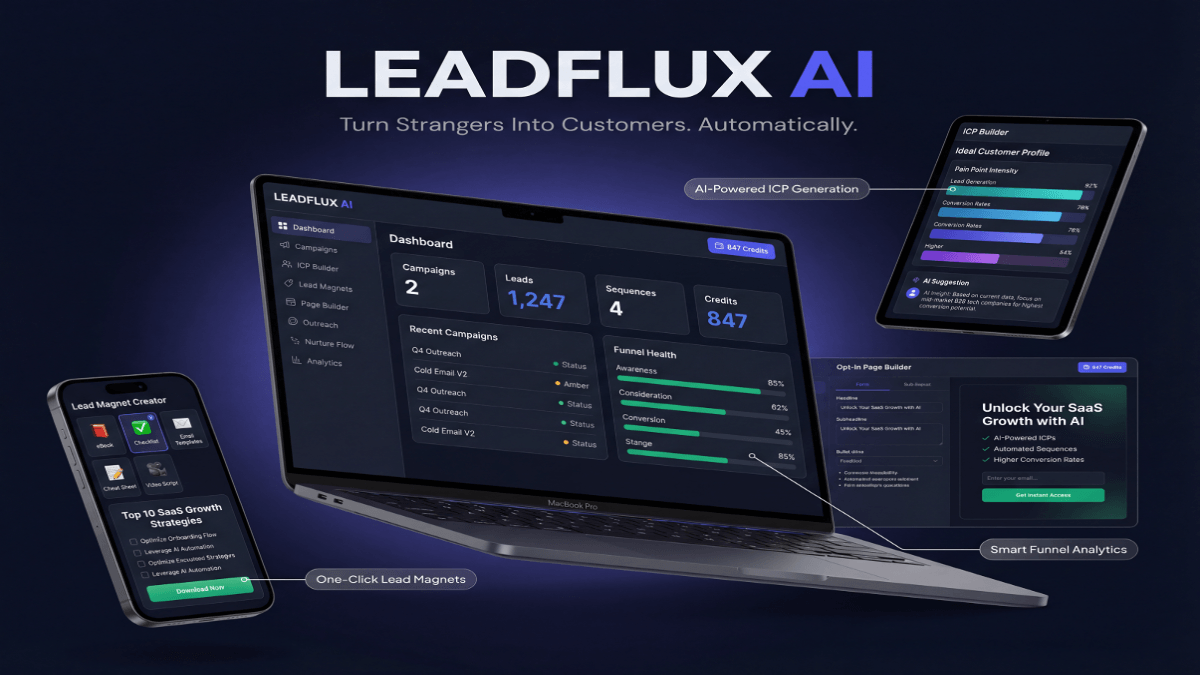
Stop Guessing. Start Converting.
LeadFlux AI Does the Heavy Lifting.
Tracking KPIs is only half the battle — you need a system that turns data into revenue. LeadFlux AI automatically identifies your highest-value prospects, scores leads in real time, and delivers conversion-ready pipelines so you can focus on closing deals, not chasing dead ends.
See How LeadFlux AI WorksMeasuring and Improving Your Sequence
Track open rates and click-through rates for every email in your sequence. Look for the drop-off points — the emails where engagement suddenly declines. These are the weak links in your chain and the highest-leverage places to invest optimization effort.
A subject line test on your lowest-performing email can lift open rates by 20 to 40 percent. A rewritten call to action on your conversion emails can double click-through rates. Systematic, one-variable-at-a-time testing turns a good nurture sequence into a great one over time.
Build It Once, Profit Indefinitely
The most powerful thing about a well-built email nurture sequence is that you write it once and it works forever. Every new subscriber who enters your list receives the same carefully crafted journey — automatically, without any additional effort from you. That is the definition of a scalable lead generation asset.
Start with a five-email sequence if ten feels overwhelming. A focused five-email sequence that delivers real value and makes one clear offer will outperform a bloated twenty-email sequence full of filler content every time.
Internal linking suggestions: Connect this post to your articles on lead magnet formats, landing page copywriting, cold email outreach, the Audience Ignition System, and analytics and metrics tracking.
External resource topics: Email marketing platform automation guides, email copywriting frameworks, subscriber segmentation strategies, A/B testing methodologies for email, and deliverability optimization resources.