Every business needs a systematic way to turn strangers into customers. That’s exactly what sales funnels accomplish. A well-designed sales funnel guides prospects through each stage of the buying journey — from initial awareness to final purchase and beyond — by delivering the right message at the right time. Unlike random marketing tactics, sales funnels create predictable, repeatable revenue by mapping your customer’s decision-making process and removing friction at every step. Learn more about build a converting sales funnel.
Whether you’re a solopreneur launching your first digital product or a growing service business scaling your client acquisition, understanding how to build and optimize sales funnels is non-negotiable. This guide walks you through everything you need to know about creating conversion systems that actually work. Learn more about sales funnel strategy.
What Are Sales Funnels and Why They Matter
A sales funnel is a structured series of steps that move potential customers from initial awareness of your solution to becoming paying clients. The funnel metaphor reflects reality: you start with many prospects at the top, and fewer qualified buyers emerge at the bottom. Each stage filters and nurtures your audience. Learn more about automate your sales funnel.
Traditional marketing often scatters attention across disconnected tactics. Sales funnels fix this by creating a cohesive system where every touchpoint serves a specific purpose. You’re not just generating traffic — you’re converting it. You’re not just collecting leads — you’re qualifying and nurturing them toward a buying decision. Learn more about sales funnel software tools.
The real power of a funnel lies in its ability to automate and scale your sales process. Once built, it works 24/7, converting prospects while you sleep. More importantly, it gives you data: conversion rates at each stage, drop-off points, and clear metrics for improvement. Learn more about marketing automation funnels.
The Four Core Stages of Every Sales Funnel
While funnels vary by industry and offer, they all follow a similar structure. Understanding these stages helps you design better customer journeys and identify where prospects get stuck.
Awareness Stage: Getting Discovered
At the top of the funnel, prospects don’t know you exist. Your job is to get in front of them when they’re searching for solutions. Content marketing, SEO, social media, paid ads, and partnerships all drive awareness. The goal isn’t to sell — it’s to educate and attract the right audience.
Strong awareness content addresses pain points your ideal customer actually experiences. Blog posts, videos, podcasts, and social content work best here. Focus on providing value before asking for anything in return.
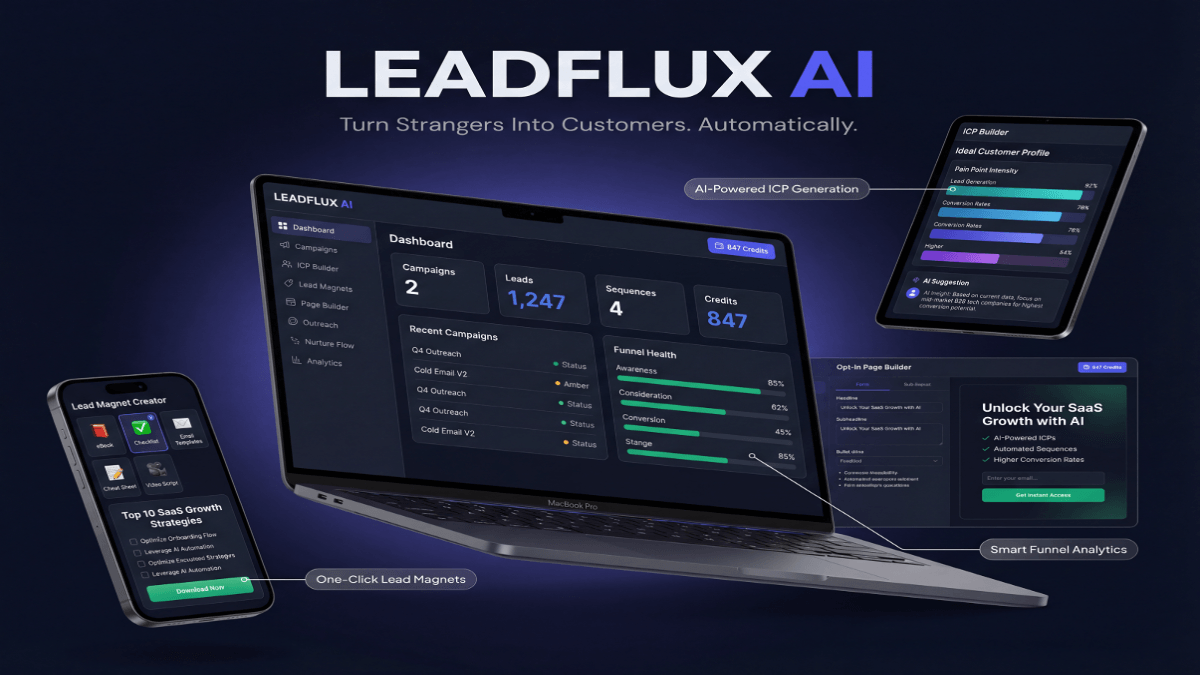
Stop Guessing. Start Converting.
LeadFlux AI Does the Heavy Lifting.
Tracking KPIs is only half the battle — you need a system that turns data into revenue. LeadFlux AI automatically identifies your highest-value prospects, scores leads in real time, and delivers conversion-ready pipelines so you can focus on closing deals, not chasing dead ends.
See How LeadFlux AI WorksInterest Stage: Building Trust and Credibility
Once someone knows you exist, they need a reason to care. The interest stage deepens engagement by offering more substantial value in exchange for contact information. Lead magnets like guides, templates, webinars, and assessments work well here.
This is where you transition from anonymous traffic to identified leads. Your email list becomes your most valuable asset. Every piece of content at this stage should demonstrate expertise and position your solution as the logical next step.
Decision Stage: Presenting Your Solution
Now prospects are evaluating options. They’re comparing you to competitors and assessing whether your solution fits their needs. Case studies, product demos, free trials, and comparison content help them make informed decisions.
Address objections head-on. Price concerns, implementation questions, and feature comparisons should all be handled transparently. The decision stage is where trust converts into action.
Action Stage: Converting to Customers
The bottom of the funnel is where prospects become customers. Remove every possible barrier to purchase. Simplify your checkout process, offer clear pricing, provide multiple payment options, and make guarantees visible.
But the funnel doesn’t end at purchase. Post-purchase onboarding, upsells, retention campaigns, and referral programs extend the customer lifecycle. Smart businesses treat the first sale as the beginning of a relationship, not the end.
<!– wp:paragraph {"className":"sabgp-clinkApplying these strategies consistently is what separates businesses that grow predictably from those that struggle to gain traction. Start with one tactic, measure the results, and build from there.