Marketing Automation Lead Handoff Protocol: Sales Team Integration That Converts 38% More Qualified Leads
The moment a qualified lead moves from marketing to sales is make-or-break. Yet most companies treat this critical handoff like a relay race where nobody practiced passing the baton. Marketing generates leads, tosses them over the fence, and sales scrambles to figure out what to do with them. The result? Confused prospects, frustrated sales reps, and conversion rates that leave money on the table. Learn more about marketing automation workflow benchmarks.
Companies with formal marketing automation lead handoff protocols convert 38% more qualified leads than those winging it. That’s not a marginal improvement, that’s transformational growth using the same traffic and budget you already have. The difference lies in creating a systematic, automated process that ensures every qualified lead receives the right follow-up at the right time with the right context. Learn more about lead scoring system.
This guide reveals the exact lead handoff protocol that top-performing sales and marketing teams use to maximize conversions. You’ll learn how to build lead scoring criteria, automate handoff triggers, equip sales with actionable intelligence, and create feedback loops that continuously improve your system. Learn more about marketing to sales SLA templates.
Why Most Lead Handoffs Fail (And How Yours Will Succeed)
The typical lead handoff looks like this: Marketing declares a lead qualified based on form fills or email engagement, then dumps that lead into the CRM with minimal context. Sales receives a notification, sees a name and email address, and makes a cold call to someone they know nothing about. The prospect feels ambushed because they’re not actually ready to buy. Learn more about workflow documentation template.
This approach fails for three fundamental reasons. First, marketing and sales use different definitions of what makes a lead qualified. Marketing counts engagement signals while sales needs buying intent. Second, the handoff lacks context about the prospect’s journey, pain points, and interests. Third, timing is arbitrary rather than based on actual buying signals. Learn more about workflow performance audit KPIs.
A proper marketing automation lead handoff protocol solves these problems by establishing shared definitions, capturing behavioral intelligence, and triggering handoffs based on genuine readiness signals. When you get this right, sales calls become welcomed conversations rather than interruptions. Your close rate climbs because you’re reaching people when they actually want to hear from you.
The protocol requires alignment between marketing and sales on lead definitions, scoring criteria, handoff triggers, and follow-up expectations. It demands automation that enriches lead records with behavioral data and triggers notifications at the perfect moment. Most importantly, it needs feedback mechanisms so marketing learns which leads actually convert and adjusts scoring accordingly.
Building Your Lead Scoring Foundation for Automated Handoffs
Effective lead handoff starts with accurate lead scoring. Your marketing automation platform must assign points based on demographic fit and behavioral engagement to identify when prospects cross the threshold from marketing-qualified to sales-ready. Without proper scoring, you’ll either overwhelm sales with unqualified leads or let hot prospects go cold.
Demographic scoring evaluates how well a lead matches your ideal customer profile. Assign points for job title, company size, industry, budget authority, and geographic location. A VP at a 200-person company in your target industry should score higher than an intern at a 10-person startup outside your wheelhouse. This prevents wasting sales time on prospects who will never buy regardless of interest level.
Behavioral scoring tracks engagement signals that indicate genuine interest and buying intent. Website visits to pricing pages, product comparison downloads, webinar attendance, email link clicks, and demo requests all signal readiness. The key is weighting these actions appropriately based on their correlation with actual closed deals in your data.
| Scoring Category | Action/Attribute | Point Value | Rationale |
| Demographic | Director+ Title | +15 | Decision-making authority |
| Demographic | Target Industry | +10 | Product-market fit |
| Demographic | Company Size 50-500 | +10 | Ideal customer profile |
| Behavioral | Pricing Page Visit | +20 | High purchase intent |
| Behavioral | Case Study Download | +15 | Evaluating solutions |
| Behavioral | Webinar Attendance | +15 | Active research phase |
| Behavioral | Blog Post Read | +3 | Awareness building |
| Behavioral | Email Open | +1 | Basic engagement |
Set your handoff threshold collaboratively with sales. Most companies find sweet spots between 50-75 points, but your number depends on your scoring scale and sales capacity. Test different thresholds and track conversion rates to find the score that maximizes both volume and quality. Too low overwhelms sales with tire-kickers, too high lets hot leads cool off.
Implement negative scoring to prevent false positives. Deduct points for unsubscribes, job titles that indicate students or job seekers, free email domains for B2B companies, and competitors researching your positioning. This refinement ensures your sales team focuses energy on genuine prospects rather than chasing ghosts.
Creating Handoff Triggers That Match Prospect Readiness
Lead score crossing your threshold is necessary but not sufficient for handoff. Smart protocols layer additional triggers that indicate the prospect is in an active buying window rather than just casually browsing. Multiple signals create confidence that sales outreach will be welcomed rather than resented.
Time-based triggers recognize that engagement patterns matter as much as total engagement. A lead who accumulates 60 points over six months shows different intent than one who hits 60 points in three days. Velocity scoring identifies prospects experiencing urgent pain points who are rapidly consuming content and evaluating solutions right now.
Intent-based triggers monitor specific high-value actions that correlate strongly with purchase readiness. These include requesting demos, visiting pricing pages multiple times, downloading comparison guides, attending product webinars, or asking questions about implementation. Configure your marketing automation to flag these moments immediately because they represent narrow windows of opportunity.
You can also set up trigger combinations that require both score threshold AND specific actions. For example, a lead must reach 60 points AND visit the pricing page, or achieve 70 points AND download a case study. This dual-gate approach dramatically improves lead quality by ensuring prospects have both fit and intent before entering the sales pipeline.
Consider creating multiple handoff tiers based on urgency. Hot leads showing immediate buying signals get routed instantly to sales for same-day follow-up. Warm leads meeting score thresholds but lacking urgent signals enter a sales-ready nurture sequence that continues adding value while alerting sales to begin research. This tiered approach optimizes sales time allocation toward the highest-probability opportunities.
Enriching Lead Records With Intelligence Sales Actually Needs
The handoff isn’t complete when you notify sales that a lead is ready. That’s just the beginning. Sales needs contextual intelligence about the prospect’s journey, pain points, interests, and engagement history to have productive conversations. Your marketing automation system must automatically compile and present this intelligence in an instantly digestible format.
Behavioral profiles summarize what content the prospect consumed, which emails they engaged with, what pages they visited, and how recently they took action. This tells sales what topics interest the prospect, what problems they’re trying to solve, and where they are in the buying journey. A prospect who downloaded a beginner’s guide needs different conversation than one comparing enterprise features.
Engagement recency and frequency matter enormously. Knowing someone visited your pricing page yesterday versus three weeks ago changes your approach entirely. Configure your system to highlight the most recent activities and flag prospects who’ve gone dark after initial engagement. This temporal context helps sales prioritize outreach and tailor messaging appropriately.
Include firmographic data enrichment to arm sales with conversation starters and credibility builders. Company size, industry, technology stack, recent news, and competitive intelligence help sales reps prepare relevant talking points. When a rep can reference a prospect’s recent funding round or industry challenge, conversations start from a position of knowledge rather than cold discovery.
Campaign source attribution reveals which marketing efforts brought this lead into your ecosystem. Knowing whether someone came from a webinar, content download, PPC ad, or organic search helps sales understand context and expected knowledge level. Someone who attended your webinar has different awareness than someone who clicked a Facebook ad for a free template.
Create sales enablement notifications that deliver this intelligence through their preferred channels. Most sales reps don’t live in marketing automation platforms, so push relevant information to them via CRM notifications, Slack messages, or email alerts that include all the context they need to make their first touchpoint valuable.
Automating the Technical Handoff Between Systems
The technical integration between your marketing automation platform and CRM determines whether handoffs happen smoothly or fall through cracks. Proper configuration ensures leads move automatically with complete data integrity, trigger appropriate workflows, and create visibility for both teams about handoff status.
Native integrations between major platforms like HubSpot, Marketo, Pardot, ActiveCampaign, and Salesforce handle basic data syncing. However, you must configure field mapping carefully to ensure behavioral scores, engagement history, and custom attributes transfer correctly. Missing fields mean sales loses critical context even if the lead record moves over successfully.
Set up automated task creation in your CRM when leads cross handoff thresholds. These tasks should assign to specific reps based on territory, industry, or round-robin distribution, include due dates that enforce response time SLAs, and contain prefilled notes with key intelligence from the marketing automation platform. This eliminates ambiguity about who owns the lead and what they should do with it.
Configure lead status workflows that update automatically as leads progress through sales stages. When sales accepts a lead, that status should sync back to marketing automation so you can track acceptance rates. When leads become opportunities, close-won, or close-lost, that feedback must flow back to marketing to inform scoring model improvements.
Build notification systems that alert appropriate team members at each handoff stage. Marketing managers should know when leads enter sales-ready status. Sales managers need visibility when new leads hit their team’s queue. Individual reps require immediate alerts for hot leads demanding urgent follow-up. Layer these notifications across email, CRM, and team communication platforms to ensure nothing slips through.
For organizations using multiple tools, consider iPaaS solutions like Zapier, Make.com, or Workato to orchestrate complex handoff workflows. These platforms can trigger actions across multiple systems, ensuring that lead handoff updates Slack channels, creates calendar reminders, sends text message alerts, and logs activities in project management tools simultaneously.
Establishing Response Time SLAs That Protect Conversion Rates
Speed kills in lead follow-up, but in a good way. Research consistently shows that leads contacted within five minutes are 21 times more likely to convert than those reached after 30 minutes. Yet the average response time at most companies stretches to 42 hours. This delay evaporates the advantage your marketing automation created by identifying ready prospects at the perfect moment.
Implement tiered response time SLAs based on lead temperature. Hot leads showing immediate buying signals demand same-day contact, ideally within the hour. Warm leads meeting score thresholds merit 24-hour follow-up. Even marketing-qualified leads not yet sales-ready deserve acknowledgment within 48 hours to maintain engagement and gather additional qualifying information.
Build response time accountability into your marketing automation workflows. Set up automated escalations when SLAs are breached, notifying sales managers if a hot lead sits untouched for two hours. Create dashboards showing average response times by rep, team, and lead source so leadership can identify bottlenecks and coaching opportunities.
Consider automated first-touch responses while sales reps prepare for outreach. When someone requests a demo, instantly send a confirmation email thanking them, setting expectations for when they’ll hear from sales, and providing additional resources to maintain engagement. This buys your team breathing room without leaving prospects in the dark.
For highest-value leads, implement instant notification systems that bypass normal queues. SMS alerts, phone calls, or priority flags in the CRM ensure your best reps know immediately when a dream prospect takes action. These premium leads justify interrupting sales activities because their revenue potential and conversion probability dwarf typical opportunities.
Building Feedback Loops That Continuously Improve Lead Quality
Your initial lead handoff protocol represents your best educated guess about what makes prospects sales-ready. The real optimization happens when you close the feedback loop between sales outcomes and marketing automation scoring. This continuous improvement cycle separates good programs from great ones that compound results over time.
Require sales to provide disposition codes when accepting, rejecting, or closing leads. These codes categorize why leads didn’t convert: not qualified, wrong timing, no budget, chose competitor, or won deal. This structured feedback reveals patterns about which scored leads actually have buying potential versus which gaming your scoring system with engagement but no intent.
Schedule monthly lead quality reviews where marketing and sales analyze conversion data together. Compare lead scores against actual close rates to identify disconnects. If leads scoring 80+ points convert at the same rate as 60-point leads, your high-score criteria need adjustment. If certain lead sources consistently produce junk despite good scores, add negative scoring for those sources.
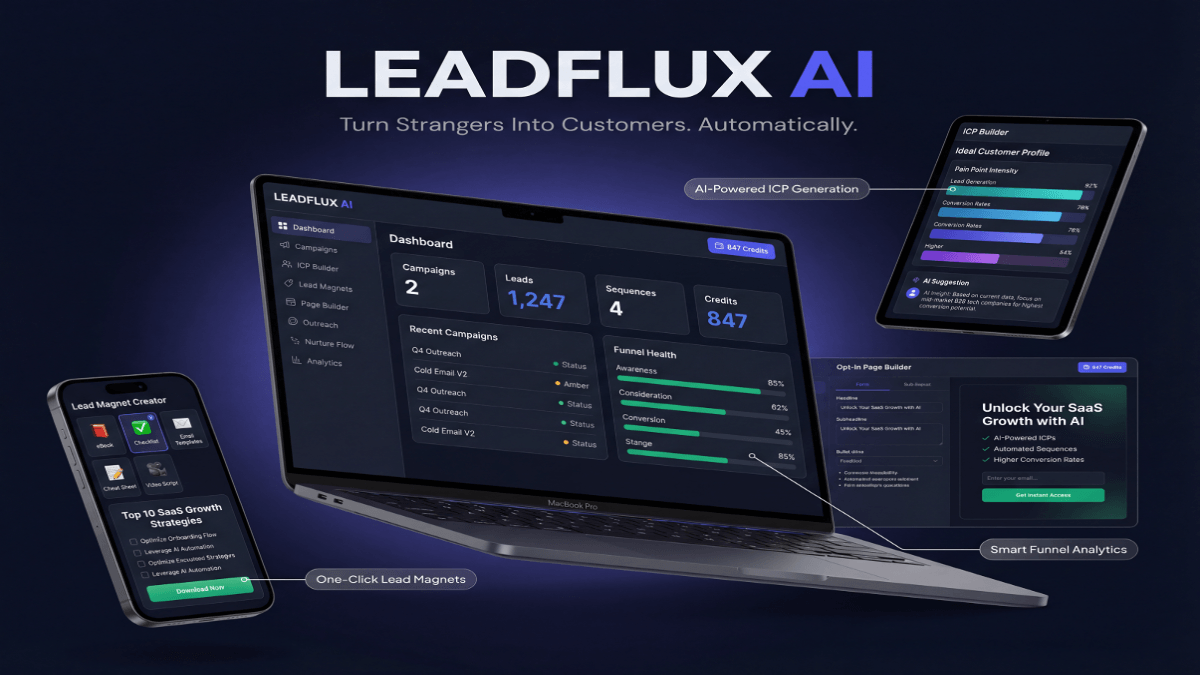
Stop Guessing. Start Converting.
LeadFlux AI Does the Heavy Lifting.
Tracking KPIs is only half the battle — you need a system that turns data into revenue. LeadFlux AI automatically identifies your highest-value prospects, scores leads in real time, and delivers conversion-ready pipelines so you can focus on closing deals, not chasing dead ends.
See How LeadFlux AI WorksTrack leading and lagging indicators of handoff protocol effectiveness. Leading indicators include lead acceptance rate, speed-to-contact, and meeting booking rate. Lagging indicators cover sales cycle length, close rate, and revenue per lead. Monitor both types to spot problems early and measure true business impact over time.
Use closed-won analysis to reverse-engineer ideal customer profiles. Export all closed deals from the past year and analyze their original lead scores, engagement patterns, demographic attributes, and content consumption. Look for commonalities that your current scoring model might be underweighting. Maybe webinar attendees convert at twice the rate you thought, justifying higher point values.
Create regular rhythm for iterating your scoring model based on feedback data. Quarterly reviews allow enough time to gather meaningful conversion data without letting bad models persist too long. Test scoring changes with holdout groups when possible to validate improvements before rolling out broadly. Treat your lead handoff protocol as a living system that evolves with your business.
Document every scoring change with rationale and expected impact. This historical record prevents repeatedly testing failed approaches and helps onboard new team members to your methodology. It also creates accountability by making predictions explicit so you can evaluate whether changes delivered promised improvements.
Implementing Your Marketing Automation Lead Handoff Protocol
You now have the framework for a lead handoff protocol that converts 38% more qualified leads. Implementation starts with alignment, progresses through technical configuration, and matures through continuous optimization. Begin by bringing marketing and sales leadership together to agree on definitions, thresholds, and responsibilities.
Start simple rather than trying to build the perfect system immediately. Implement basic lead scoring with 10-15 criteria, establish clear handoff thresholds, and create automated notifications. Get this foundation working reliably before layering in sophisticated velocity scoring, multiple tiers, or complex enrichment workflows. Early wins build momentum and stakeholder buy-in for future enhancements.
Pilot your protocol with a subset of leads or a single sales team before company-wide rollout. This controlled test reveals technical issues, process gaps, and change management needs while limiting downside risk. Use pilot feedback to refine documentation, training, and automation before expanding to full production.
Invest heavily in training both marketing and sales teams on the new protocol. Marketing must understand how their campaigns and content influence lead scores and handoff timing. Sales needs training on how to interpret lead intelligence, prioritize follow-up, and provide quality feedback. Schedule role-playing sessions where sales practices first conversations using the enriched lead context your system provides.
Create clear documentation that both teams can reference when questions arise. Include lead scoring criteria and rationale, handoff threshold definitions, response time SLAs, CRM field definitions, and troubleshooting guides for common issues. Maintain this documentation in a shared wiki or knowledge base where updates automatically notify relevant team members.
The transformation from ad hoc lead handoffs to systematic protocol won’t happen overnight. Commit to the process, measure relentlessly, iterate based on data, and celebrate improvements. Within three to six months, you’ll see the 38% conversion lift materialize as your teams work in concert rather than conflict. That’s when marketing automation fulfills its promise of making every lead count.
Related resources: Learn more about optimizing your marketing automation strategy with our guides on lead scoring best practices, sales and marketing alignment tactics, and CRM integration strategies. For external tools and frameworks, explore the Marketing Automation Institute’s resources on lead lifecycle management and Salesforce’s best practices for marketing-sales handoffs.