Choosing between Facebook Lead Ads and dedicated landing pages represents one of the most consequential decisions in modern lead generation strategy. Both approaches deliver qualified prospects, yet they differ dramatically in conversion mechanics, cost structure, and lead quality outcomes. Understanding these distinctions allows marketers to allocate budgets strategically and maximize return on advertising spend across campaign objectives. Learn more about cost per lead analysis.
Facebook Lead Ads promise frictionless lead capture directly within the platform, eliminating redirect delays and pre-filling user information automatically. Landing pages, conversely, require additional clicks but offer comprehensive customization, detailed value propositions, and sophisticated tracking capabilities. The performance gap between these methods varies substantially across industries, audience segments, and offer complexity levels. Learn more about conversion rate optimization strategies.
This comparison examines conversion rate benchmarks, cost-per-lead economics, lead quality differences, and strategic implementation frameworks. Marketers will discover which approach aligns with specific campaign goals, how to test both methodologies systematically, and when hybrid strategies deliver superior results. The data-driven insights presented here eliminate guesswork from lead generation channel selection. Learn more about landing page optimization tactics.
Understanding Facebook Lead Ads Conversion Mechanics
Facebook Lead Ads utilize native form technology that keeps users within the Facebook ecosystem throughout the entire conversion process. When prospects click an ad, a pre-populated form appears instantly, displaying information Facebook already possesses including name, email address, phone number, and demographic data. This auto-fill functionality reduces form completion time from minutes to seconds, eliminating the most significant barrier in traditional lead capture workflows. Learn more about Facebook lead generation case study.
The streamlined experience typically generates conversion rates between 12% and 18% across most industries, substantially higher than standard landing page benchmarks. Financial services companies report conversion rates reaching 25% for retirement planning offers, while B2B software providers see rates between 8% and 14% depending on offer complexity. The reduced friction directly translates to volume increases, particularly valuable for top-of-funnel awareness campaigns targeting cold audiences. Learn more about multi-step form conversion data.
After testing dozens of automation platforms, I’ve found that LeadFlux AI for lead scoring significantly reduces the time spent qualifying prospects by using behavioral data to prioritize your hottest leads automatically.
Mobile optimization represents another critical advantage, as Facebook Lead Ads eliminate the page load delays and formatting inconsistencies that plague mobile landing pages. Mobile users convert at nearly identical rates to desktop users within Lead Ads, whereas landing pages typically see 40-60% lower mobile conversion rates. This mobile parity proves essential given that 78% of Facebook ad clicks originate from mobile devices in most campaign configurations.
However, the simplified process introduces qualification challenges. The minimal effort required means prospects often submit information impulsively without fully understanding the offer or commitment level. This generates higher form submission volumes but frequently produces leads with lower purchase intent, longer sales cycles, and reduced close rates. The quality versus quantity trade-off requires careful consideration based on sales team capacity and customer lifetime value economics.
Landing Page Performance Benchmarks and Advantages
Dedicated landing pages provide comprehensive control over messaging hierarchy, visual design, social proof placement, and conversion path psychology. Marketers can implement extensive value explanations, address objections systematically, showcase detailed testimonials, and create urgency through strategic copywriting techniques. This expanded canvas allows sophisticated persuasion architectures impossible within Facebook’s constrained Lead Ad format.
Conversion rates for optimized landing pages typically range between 5% and 12% across industries, with exceptional performers reaching 15-20% through rigorous testing programs. The lower baseline compared to Lead Ads reflects additional friction points including page load time, form field completion effort, and the psychological commitment of leaving Facebook’s familiar environment. Each additional click in the conversion funnel creates approximately 20-30% drop-off in standard configurations.
The quality differential favors landing pages decisively. Prospects who navigate to a separate page, consume detailed content, and manually complete form fields demonstrate substantially higher engagement levels and purchase readiness. Sales teams report 40-60% higher contact rates, 25-45% shorter sales cycles, and conversion-to-customer rates that exceed Lead Ad sources by 35-70% in comparable campaigns.
| Metric | Facebook Lead Ads | Landing Pages |
|---|---|---|
| Average Conversion Rate | 12-18% | 5-12% |
| Mobile Conversion Rate | 11-17% | 3-7% |
| Contact Success Rate | 45-60% | 70-85% |
| Lead-to-Customer Rate | 2-4% | 5-9% |
| Average Sales Cycle | 45-60 days | 30-42 days |
Landing pages excel in complex offer scenarios requiring extensive explanation, high-consideration purchases, and sophisticated buyer personas. Enterprise software sales, professional services engagements, and premium product launches benefit dramatically from the expanded storytelling capacity. The ability to segment traffic through multiple landing page variations also enables precise message-market matching impossible with standardized Lead Ad formats.
Cost-Per-Lead Economics and Budget Implications
Facebook Lead Ads generally produce lower nominal cost-per-lead figures, with typical ranges between $3 and $15 depending on industry competitiveness and audience targeting parameters. The higher conversion rates directly reduce cost-per-acquisition at the top of the funnel, making Lead Ads particularly attractive for volume-focused campaigns and limited budget scenarios. B2C brands frequently achieve sub-$5 CPL for newsletter signups, content downloads, and webinar registrations.
Landing page campaigns typically generate cost-per-lead figures between $8 and $40, reflecting lower conversion rates and identical traffic costs. The increased friction reduces conversion volume, distributing fixed advertising costs across fewer leads. However, evaluating cost efficiency requires examining cost-per-qualified-lead and cost-per-customer metrics rather than isolated CPL numbers that ignore downstream conversion performance.
When analyzing qualified lead economics, the picture shifts substantially. If Lead Ads generate leads at $5 CPL with 3% customer conversion rates, the effective customer acquisition cost reaches $167. Landing pages producing $20 leads with 8% customer conversion yield $250 CAC, but the quality differential often justifies the premium through higher average order values, superior retention rates, and increased lifetime value.
Hidden costs associated with Lead Ads include CRM integration expenses, lead validation tools to filter low-quality submissions, and sales team time wasted pursuing unqualified prospects. Landing pages incur development costs, ongoing optimization expenses, and hosting infrastructure fees. Total cost of ownership calculations must account for these operational factors beyond nominal advertising expenditure.
Budget allocation strategy depends heavily on business model constraints. Companies with limited sales capacity benefit from landing pages that pre-qualify prospects effectively, preventing team overwhelm from excessive low-quality volume. Organizations with scalable sales processes and automated nurture sequences can leverage Lead Ads’ volume advantages, using behavioral scoring and progressive profiling to identify serious buyers within large lead pools.
Strategic Implementation Framework for Channel Selection
Effective channel selection begins with offer complexity assessment. Simple, low-friction offers like newsletter subscriptions, discount codes, or content downloads perform exceptionally well through Lead Ads where explanation requirements are minimal. The instant gratification of immediate access aligns perfectly with the streamlined submission process, creating coherent user experiences that maximize conversion probability.
Complex offers requiring detailed value propositions, price justification, or feature comparisons demand landing page environments. Enterprise software trials, consulting service inquiries, and premium product purchases need comprehensive information architecture to address objections and build purchase confidence. The expanded canvas allows strategic information sequencing that guides prospects through consideration processes systematically.
Audience awareness level significantly impacts channel performance. Cold audiences unfamiliar with your brand convert more readily through Lead Ads’ minimal commitment threshold, allowing initial relationship establishment without demanding extensive engagement. These contacts enter nurture sequences for gradual warming through email campaigns, retargeting exposure, and content consumption before sales conversations commence.
Warm audiences already familiar with your value proposition, having consumed content or engaged with previous campaigns, respond well to landing pages offering deeper engagement opportunities. These prospects possess sufficient context to evaluate detailed offers and demonstrate higher propensity for immediate conversion when presented with compelling calls-to-action. The additional friction serves as a qualification filter rather than a barrier.
Testing methodology should compare both approaches systematically rather than relying on assumptions. Split budget allocation equally between Lead Ads and landing page campaigns targeting identical audiences with equivalent offers. Track not only cost-per-lead metrics but complete funnel performance including contact rates, opportunity creation, close rates, and customer lifetime value across 90-day windows minimum.
Companies that test both Lead Ads and landing pages simultaneously discover that optimal performance typically involves hybrid strategies, with Lead Ads capturing volume at top-of-funnel and landing pages converting warmed retargeting audiences.
Optimization Tactics for Maximum Performance
Facebook Lead Ads optimization begins with form design simplification. Limit fields to absolute necessities, typically name and email for initial capture, with progressive profiling gathering additional data through subsequent interactions. Each additional form field reduces completion rates by approximately 5-10%, making minimalism essential for volume maximization. Custom questions should provide genuine qualification value rather than satisfying data collection curiosity.
Privacy policy transparency and clear value communication in form context text significantly impact completion rates. Prospects need immediate clarity regarding what happens after submission, whether they receive instant content access, schedule consultation calls, or enter email sequences. Ambiguity creates hesitation, while explicit benefit statements and process explanations build confidence and reduce abandonment.
Landing page optimization follows conversion rate optimization principles including singular focus maintenance, distraction elimination, and strategic social proof placement. Remove navigation menus, sidebar elements, and footer links that provide escape routes from conversion paths. Every page element should either advance prospects toward form completion or address specific objections preventing submission.
Headline and subheadline clarity determines whether prospects invest attention in page content. Lead with specific benefit statements rather than vague brand messaging, using concrete numbers and outcome descriptions that resonate with target audience pain points. The headline-subheadline combination should communicate complete value propositions independently, as many visitors never scroll beyond the initial viewport.
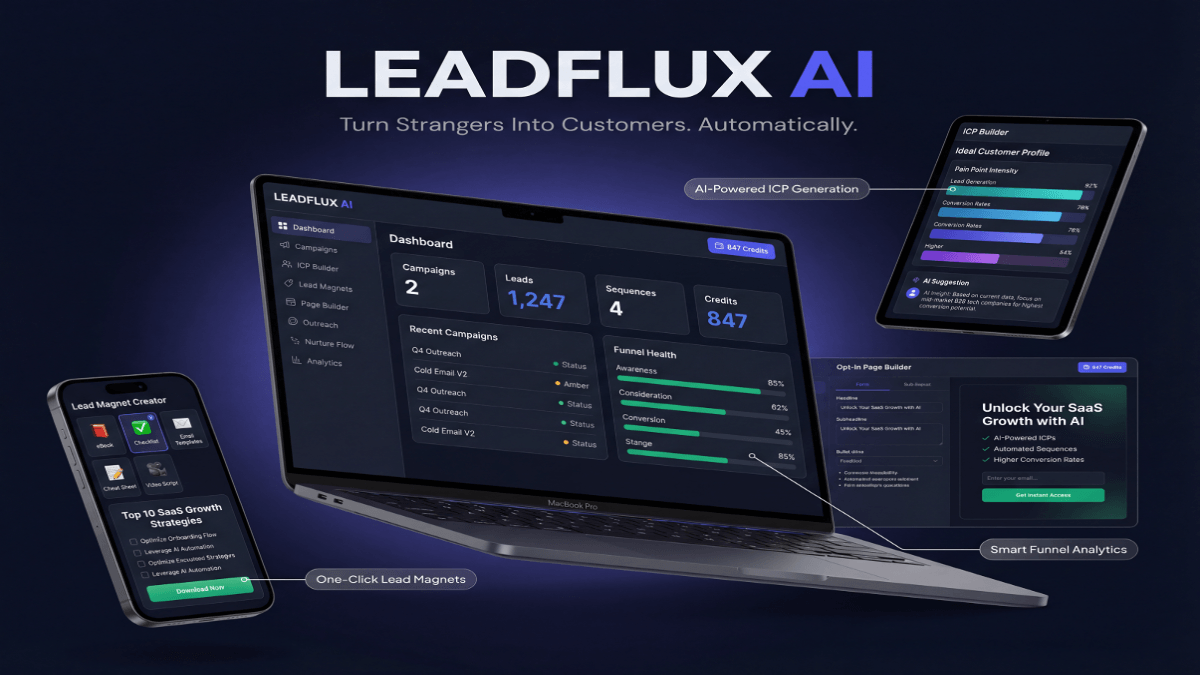
Stop Guessing. Start Converting.
LeadFlux AI Does the Heavy Lifting.
Tracking KPIs is only half the battle — you need a system that turns data into revenue. LeadFlux AI automatically identifies your highest-value prospects, scores leads in real time, and delivers conversion-ready pipelines so you can focus on closing deals, not chasing dead ends.
See How LeadFlux AI WorksForm placement strategy varies based on offer complexity and page length. Simple offers benefit from above-the-fold placement maximizing immediate visibility, while complex offers require value-building content before form introduction. Multi-step forms reduce psychological resistance by displaying one or two fields initially, revealing additional requirements only after partial commitment through progressive disclosure techniques.
Visual hierarchy optimization guides attention systematically through persuasion sequences. Use contrasting colors for call-to-action buttons, directional cues like arrows or eye gaze in images, and whitespace to create breathing room around critical elements. Heat mapping tools reveal actual attention patterns, enabling data-driven design iterations that align visual emphasis with conversion priorities.
Load speed optimization proves critical for landing page performance, as each additional second of delay reduces conversions by approximately 7%. Compress images aggressively, minimize JavaScript execution, leverage browser caching, and utilize content delivery networks for global audience serving. Mobile performance deserves particular attention given traffic composition, with 3-second maximum load times as non-negotiable targets.
Both methodologies benefit from strategic audience segmentation and creative variation testing. Develop distinct ad creative and form experiences for different demographic segments, job roles, and behavioral cohorts rather than applying one-size-fits-all approaches. Personalization based on referral source, device type, or previous engagement history can lift conversion rates 15-40% through relevance enhancement.
Making the Strategic Decision
The choice between Facebook Lead Ads and landing pages ultimately depends on specific business contexts rather than universal best practices. Organizations prioritizing lead volume for extensive nurture programs benefit from Lead Ads’ conversion rate advantages and lower initial cost-per-lead economics. The quality trade-off becomes acceptable when sophisticated scoring systems and automated qualification workflows identify serious prospects within large pools.
Businesses with limited sales capacity or high-touch sales processes should favor landing pages that pre-qualify prospects effectively. The quality premium justifies higher nominal costs when sales team time represents the constraining resource. Premium service providers, enterprise software companies, and consultative sellers particularly benefit from self-selection dynamics that landing page friction creates naturally.
Hybrid strategies often deliver optimal results by leveraging each method’s strengths strategically. Use Lead Ads for initial audience capture and awareness building, then retarget engaged prospects with landing page campaigns offering deeper value and higher commitment levels. This sequenced approach maximizes volume capture while providing qualification pathways for serious buyers ready for sales conversations.
Continuous testing remains essential regardless of initial channel selection. Market conditions evolve, audience preferences shift, and competitive dynamics change performance benchmarks over time. Quarterly testing cycles comparing both approaches ensure strategy alignment with current realities rather than outdated assumptions, allowing agile optimization as campaign performance data accumulates.