Email accessibility isn’t just a nice-to-have feature—it’s a strategic imperative that directly impacts your bottom line. When you optimize your email campaigns for accessibility, you’re not simply being inclusive; you’re unlocking access to a substantial segment of your audience that traditional email designs systematically exclude. Learn more about email frequency optimization.
The numbers tell a compelling story: approximately one billion people worldwide live with some form of disability. In your subscriber base, that translates to roughly 15-20% of recipients who may struggle with conventional email designs. These individuals rely on assistive technologies like screen readers, voice controls, and keyboard navigation to consume digital content. When your emails aren’t optimized for these technologies, you’re essentially rendering your message invisible to a significant portion of your list. Learn more about email segmentation strategies.
The business case for email accessibility extends beyond moral obligation. Accessible emails consistently demonstrate higher engagement rates across all user segments, not just those using assistive technology. Clear hierarchies, logical content flow, and semantic HTML structure improve readability for everyone. The optimization techniques that make emails screen reader-friendly simultaneously enhance deliverability, reduce spam complaints, and improve conversion rates across your entire subscriber base. Learn more about email mobile optimization.
Understanding Screen Reader Technology and Email Consumption
Screen readers are software applications that convert digital text into synthesized speech or refreshable Braille displays. Popular screen readers include JAWS, NVDA, VoiceOver, and TalkBack. These tools interpret the underlying HTML structure of your emails, not the visual presentation that sighted users experience. Learn more about email list growth strategies.
When a screen reader user opens your email, the software analyzes the document structure from top to bottom, announcing headings, links, images, and other elements in sequential order. Unlike visual scanning, which allows sighted users to quickly skim content and jump to sections of interest, screen reader users navigate linearly through your content unless you’ve provided proper structural landmarks. Learn more about email authentication setup.
This fundamental difference in consumption patterns requires a strategic approach to email design. Visual hierarchy alone is insufficient—you need semantic HTML that explicitly communicates structure to assistive technologies. A heading that looks prominent due to font size and color means nothing to a screen reader unless it’s marked up with proper heading tags.
The majority of screen reader users prefer navigating content by headings, allowing them to jump between sections quickly. When emails lack proper heading structure, these users must listen to every single word in sequence, dramatically increasing the time and effort required to extract value from your message. This explains why accessibility-optimized emails see significantly higher engagement—they respect the user’s time and cognitive resources.
Core Technical Elements of Accessible Email Design
Creating screen reader-friendly emails requires attention to specific technical implementations that may not be immediately visible to sighted users but dramatically impact assistive technology interpretation.
Semantic HTML Structure
The foundation of accessible email design begins with semantic HTML. This means using HTML elements according to their intended purpose rather than for visual styling alone. Heading tags (h1, h2, h3) should be used exclusively for headings and arranged in logical hierarchical order. Paragraph tags should contain body text. Lists should use ul or ol tags rather than manually formatted text with bullets.
Many email marketing platforms default to div-based layouts with inline CSS styling that creates visual structure without semantic meaning. While these emails may look perfect in visual renderings, they present as undifferentiated text blocks to screen readers. Converting these layouts to semantic HTML dramatically improves accessibility without necessarily changing visual appearance.
The heading hierarchy deserves particular attention. Your email should contain exactly one h1 element—typically your main headline or email subject reiteration. Subsequent headings should follow logical nesting: h2 for main sections, h3 for subsections within those sections, and so forth. Skipping heading levels (jumping from h2 to h4, for example) creates navigation confusion for assistive technology users.
Alternative Text for Images
Alt text remains one of the most critical yet frequently mishandled aspects of email accessibility. Every informational image in your email requires descriptive alternative text that conveys the same information or function that the image provides to sighted users. Decorative images should include empty alt attributes (alt=””) to signal screen readers to skip them entirely.
Effective alt text is concise, descriptive, and contextually relevant. Rather than describing what the image depicts, describe what information it conveys or what action it facilitates. For a product image, instead of “red shoes,” use “Women’s athletic running shoes in cardinal red, mesh construction with white sole.” For a button image, describe the action: “Download free guide” rather than “green download button.”
Logo images present a particular challenge. Screen readers should announce your brand identity, but this shouldn’t dominate the beginning of every email. Consider placing logos later in the HTML source order using CSS positioning, or use concise alt text like “Company Name” rather than lengthy marketing taglines.
| Image Type | Alt Text Approach | Example |
|---|---|---|
| Product images | Descriptive with key attributes | “Blue canvas laptop messenger bag with leather trim, 15-inch capacity” |
| Decorative images | Empty alt attribute | alt=”” |
| Functional buttons | Action-oriented | “Schedule consultation call” |
| Infographic sections | Summary of data presented | “Bar chart showing 35% increase in conversion rates” |
| Team photos | Name and title | “Sarah Chen, Director of Customer Success” |
| Brand logos | Company name only | “Acme Corporation” |
Link Clarity and Context
Screen reader users frequently navigate content by jumping from link to link. When extracted from surrounding context, each link should clearly communicate its destination or purpose. Generic link text like “click here,” “read more,” or “learn more” becomes meaningless when encountered out of context.
Transform generic links into descriptive phrases that stand alone: “Read the complete guide to B2B lead scoring” instead of “Click here for our guide.” “Download the Q4 marketing benchmark report” instead of “Get the report.” This practice simultaneously improves accessibility and boosts click-through rates across all user segments by clearly communicating value.
For button links, ensure the entire clickable area contains descriptive text rather than relying on visual context. A button that visually appears below a product image might simply say “Buy Now” for sighted users who see the product above, but screen reader users encountering that button need complete context: “Buy premium CRM software subscription.”
Advanced Accessibility Optimization Techniques
Beyond foundational technical implementations, sophisticated accessibility optimization requires attention to content structure, information architecture, and user experience considerations that benefit all subscribers while ensuring full access for assistive technology users.
Reading Order and Content Linearization
Visual email designs often employ multi-column layouts, sidebars, and complex grid structures that create specific reading paths for sighted users. Screen readers, however, process content in source order—the sequence in which HTML elements appear in your code. When visual presentation order doesn’t match source order, screen reader users receive a fragmented, illogical experience.
Test your email’s reading order by viewing the HTML source and reading straight through from top to bottom. Does the sequence make logical sense? Does critical information appear before supporting details? Can users understand your message if they consume it strictly linearly without visual context?
For emails with complex layouts, consider restructuring your source order to prioritize logical flow over visual arrangement, then use CSS positioning to achieve your desired visual presentation. Alternatively, simplify layouts to single-column structures that naturally align visual and semantic reading order. Many accessible email templates demonstrate that elegant, effective visual designs don’t require complex multi-column layouts that sacrifice accessibility.
Color Contrast and Visual Clarity
While screen reader accessibility often focuses on non-visual access, many subscribers with disabilities retain partial vision and benefit significantly from high-contrast visual design. Low vision users, those with color blindness, and individuals experiencing age-related vision changes need sufficient contrast between text and background colors to consume your content effectively.
The Web Content Accessibility Guidelines specify minimum contrast ratios of 4.5:1 for normal text and 3:1 for large text (18pt or 14pt bold). These aren’t arbitrary numbers—they represent the threshold at which most users with moderately low vision can reliably distinguish text from background.
Never rely on color alone to convey critical information. If you highlight special offers in red, also include textual indicators like “Limited Time Offer” or visual icons. If you use color-coded categories, supplement with labels, patterns, or other distinguishing characteristics. This practice ensures full access regardless of color perception abilities.
Accessible emails generate 23% higher click-through rates and 17% better conversion rates compared to non-optimized campaigns, demonstrating that accessibility improvements benefit all users regardless of assistive technology use.
Table Structure and Data Presentation
Tables frequently appear in marketing emails to present pricing comparisons, feature matrices, or data summaries. When properly structured with semantic HTML, tables can be highly accessible. When created with layout hacks or improper markup, they become nearly incomprehensible to screen reader users.
Accessible tables require proper table, thead, tbody, th, and td elements. Header cells must use th tags with appropriate scope attributes indicating whether they label columns or rows. Complex tables with multiple header levels benefit from explicit id and headers attributes that establish relationships between data cells and their corresponding headers.
For purely decorative layout purposes, never use tables. Modern email clients support sufficient CSS positioning to eliminate the need for table-based layouts in most scenarios. When tables appear in your email, they should exclusively present tabular data where relationships between row and column headers provide meaningful context for data interpretation.
Content Strategy for Maximum Accessibility Impact
Technical implementation forms the foundation of accessible email design, but content strategy determines whether users can effectively extract value from your messages. The most perfectly coded email fails if its content is disorganized, verbose, or unclear.
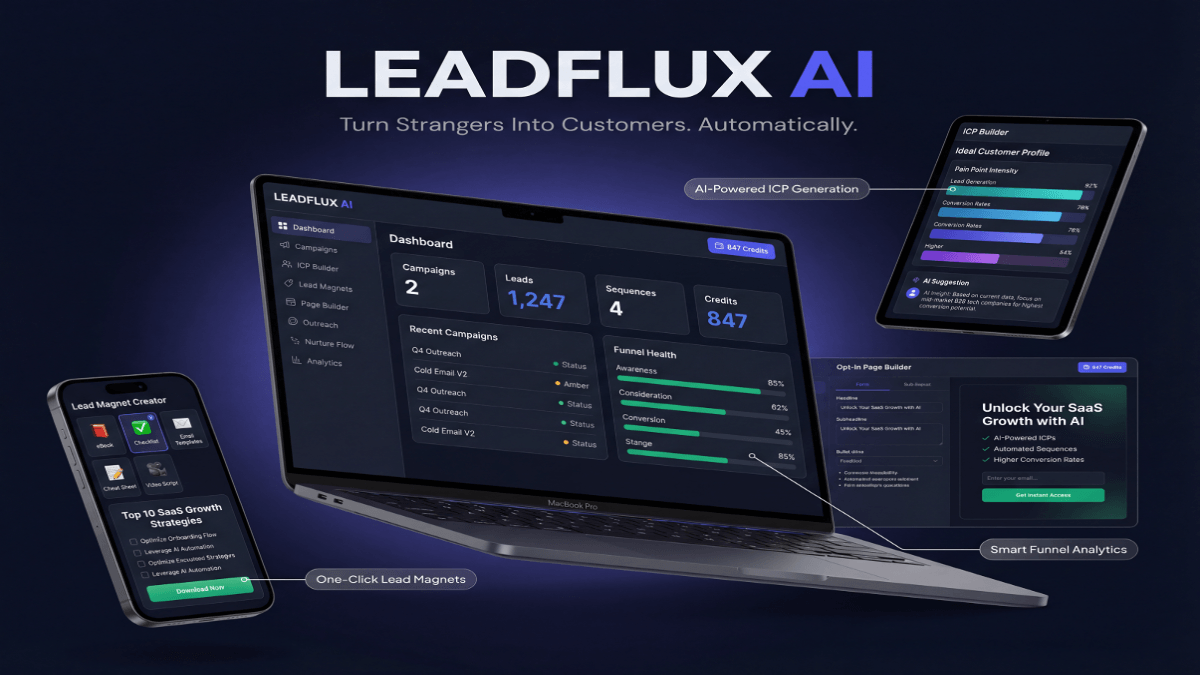
Stop Guessing. Start Converting.
LeadFlux AI Does the Heavy Lifting.
Tracking KPIs is only half the battle — you need a system that turns data into revenue. LeadFlux AI automatically identifies your highest-value prospects, scores leads in real time, and delivers conversion-ready pipelines so you can focus on closing deals, not chasing dead ends.
See How LeadFlux AI WorksFront-Loading Critical Information
Screen reader users process content linearly and may abandon emails before reaching key information buried deep in the message. Restructure your content hierarchy to surface the most important elements early. State your value proposition, key offer, or primary message in the opening sentences. Use inverted pyramid structure placing conclusions first, then supporting details.
This approach mirrors effective copywriting principles for all audiences. Every reader—regardless of assistive technology use—benefits from immediately understanding what the email offers and why it matters to them. Time-sensitive information, exclusive offers, and critical action items belong at the beginning of your message, not buried after paragraphs of preamble.
Consider implementing a brief text summary immediately after your subject line reiteration. This 1-2 sentence overview allows all users to quickly determine relevance and decide whether to invest attention in the full message. For screen reader users, this preview is especially valuable for efficiently triaging email importance.
Scannable Structure with Clear Signposting
Organize content into discrete, clearly labeled sections that users can scan and navigate efficiently. Descriptive headings serve as navigation landmarks, allowing screen reader users to jump directly to relevant sections rather than processing the entire email linearly.
Write headings that clearly communicate section content rather than creative but ambiguous phrases. “Pricing Options” immediately communicates content better than “Choose Your Adventure.” “Implementation Timeline” is clearer than “Your Journey Begins.” While creative language has its place in body copy, headings should prioritize clarity and descriptiveness.
Lists provide another powerful structural element for accessibility. Screen readers announce list contexts, informing users that a series of related items follows and specifying the number of items. This context aids comprehension and navigation. Format related items as actual HTML lists (ul or ol) rather than manually adding bullet characters to paragraphs.
- Use descriptive headings that communicate section content clearly
- Break dense paragraphs into shorter, focused chunks of 3-5 sentences
- Employ bulleted or numbered lists for series of related items or sequential steps
- Include clear transition language that connects sections and guides flow
- Provide contextual cues when referencing visual elements (“The chart below shows…”)
- Use bold or emphasis tags sparingly to highlight key terms without overusing
- Structure calls-to-action as distinct, prominently positioned elements
- Maintain consistent formatting patterns throughout your email
Plain Language and Readability
Accessible content prioritizes clear, direct language over jargon, complex sentence structures, and unnecessarily sophisticated vocabulary. While this principle particularly benefits readers with cognitive disabilities or those using translation tools, plain language improves comprehension for all audiences.
Write at an appropriate reading level for your audience—typically 8th-grade level for general audiences, potentially higher for specialized B2B contexts where industry terminology provides precision. Avoid unnecessarily complex words when simpler alternatives communicate the same meaning. Use active voice rather than passive constructions. Keep sentences concise and focused on single ideas.
When technical terminology or acronyms are necessary, define them on first use. Don’t assume familiarity even with common industry terms. This practice benefits new customers, international audiences, and anyone encountering your specific terminology for the first time.
Testing, Validation, and Continuous Improvement
Implementing accessibility best practices represents a strong start, but validation through actual testing ensures your emails function as intended for assistive technology users. Accessibility is not a checkbox feature you implement once and forget—it requires ongoing attention and iterative improvement.
Screen Reader Testing Protocols
The most reliable accessibility validation comes from testing with actual screen reader software. While automated tools identify certain technical issues, they cannot evaluate the holistic user experience that screen reader users encounter.
Test your emails across multiple screen reader and email client combinations since implementation varies. VoiceOver with Apple Mail provides different experiences than JAWS with Outlook or NVDA with Gmail. Focus testing efforts on the most popular combinations within your subscriber base, but recognize that comprehensive accessibility requires consideration of multiple scenarios.
During testing, navigate the email using only keyboard commands and screen reader output. Can you understand the message without visual reference? Does the reading order make logical sense? Are all interactive elements accessible via keyboard? Do images have appropriate alternative text? Can you efficiently navigate between sections using heading structure?
Document your testing process and results. Note which elements function well and which create barriers. Track improvements over time as you refine your approach. Consider recruiting actual assistive technology users as testers through accessibility consulting services or community partnerships—their lived experience provides insights that hypothetical testing cannot replicate.
Automated Validation Tools
While human testing provides the most comprehensive evaluation, automated accessibility checkers identify common technical issues quickly and efficiently. These tools analyze your HTML code against established guidelines, flagging problems like missing alt text, insufficient color contrast, improper heading hierarchy, and invalid markup.
Popular accessibility validation tools include WAVE, axe DevTools, and email-specific validators built into platforms like Litmus and Email on Acid. Integrate these tools into your email production workflow, checking every campaign before deployment. Address all identified issues, but recognize that passing automated validation doesn’t guarantee full accessibility—human testing remains essential.
Many email marketing platforms now include accessibility checking features in their editors, providing real-time feedback as you build campaigns. Enable these features and address flagged issues during the creation process rather than treating accessibility as a post-production audit. This proactive approach prevents accessibility debt from accumulating in your templates and workflows.
Subscriber Feedback and Engagement Metrics
Your subscribers provide valuable accessibility feedback through engagement metrics and direct communication. Monitor performance differences between accessible and non-accessible email variations. Track metrics including open rates, click-through rates, conversion rates, time spent engaging, and unsubscribe rates.
Accessible emails typically demonstrate improved performance across all metrics, not just among assistive technology users. The structural clarity, logical organization, and intentional design that benefit screen reader users simultaneously improve the experience for all subscribers. When certain emails underperform, evaluate whether accessibility gaps might contribute to lower engagement.
Provide clear channels for subscribers to report accessibility barriers. Include contact information in your email footer specifically for accessibility concerns. When users report issues, respond promptly and use their feedback to improve future campaigns. These real-world use cases provide more valuable insights than any amount of testing in controlled environments.
Platform-Specific Implementation Strategies
Different email marketing platforms provide varying levels of accessibility support and control. Understanding your platform’s capabilities and limitations allows you to maximize accessibility within technical constraints while identifying where custom development may be necessary.
Working Within Drag-and-Drop Editors
Modern email marketing platforms offer drag-and-drop editors that simplify campaign creation but sometimes generate inaccessible HTML. These visual builders may create div-based layouts lacking semantic structure, omit proper heading tags, or generate tables for layout purposes.
Research your platform’s accessibility capabilities before building campaigns. Some platforms include accessibility-focused templates with proper semantic structure. Others allow direct HTML editing where you can implement semantic markup even if the visual editor doesn’t expose these options. Still others restrict HTML editing, limiting your ability to optimize accessibility beyond what the platform provides by default.
When platform limitations prevent full accessibility implementation, prioritize the highest-impact optimizations: meaningful alt text for all images, clear link text, logical content flow, and sufficient color contrast. Document platform limitations and advocate for improvements with your vendor. Many email service providers actively expand accessibility features in response to customer feedback.
Custom HTML Email Development
Organizations with development resources can achieve maximum accessibility through custom HTML email coding. This approach provides complete control over semantic structure, reading order, and technical implementation while ensuring compatibility with diverse email clients and assistive technologies.
Start with accessible HTML email frameworks and boilerplates that provide proven semantic structures tested across multiple email clients and screen readers. These foundations handle the complex email client quirks that require non-semantic workarounds while maintaining accessibility where it matters most.
Document your accessibility standards and create reusable component libraries that codify best practices. When developers build new email templates, they can reference these components rather than reinventing implementations. This systematization ensures consistency across campaigns and prevents accessibility regressions as team members change or new templates are created.
Implement version control for your email templates, tracking changes over time and allowing rollback if updates inadvertently introduce accessibility barriers. Code reviews should explicitly evaluate accessibility alongside other quality factors, ensuring every campaign meets standards before deployment.
Template Accessibility Audits
Your email template library forms the foundation of all campaigns. Investing time in thorough accessibility audits of master templates creates leverage—improvements benefit every campaign built from those templates. Schedule regular template reviews to identify and remediate accessibility issues systematically.
Create an accessibility checklist specific to your organization’s email templates. This checklist should cover all technical requirements, content strategy considerations, and platform-specific implementation details. Use this checklist during template creation, updates, and periodic audits to maintain consistent standards.
Consider engaging accessibility specialists to conduct professional audits of your email templates. These experts identify issues that internal teams might overlook and provide specific remediation guidance. Professional audits are particularly valuable when establishing accessibility programs or addressing complex technical challenges.
Organizational Implementation and Team Training
Technical knowledge alone doesn’t ensure accessible emails—organizational commitment and team capability determine whether accessibility becomes embedded in your email marketing practice or remains an occasional consideration.
Building Accessibility Competency
Train everyone involved in email creation—marketers, designers, developers, copywriters, and stakeholders—on accessibility principles and implementation. Each role contributes to the final user experience, and gaps in any area compromise overall accessibility.
Copywriters must understand how to write descriptive link text, create logical content hierarchies, and compose effective alt text. Designers need to consider color contrast, visual clarity, and how visual layouts translate to linear reading order. Developers implement semantic HTML and ensure proper technical execution. Marketers coordinate these elements and prioritize accessibility alongside other campaign objectives.
Develop internal training materials specific to your organization’s email platform, templates, and workflows. Generic accessibility training provides valuable context, but practical implementation requires guidance tailored to your specific tools and processes. Create video tutorials, documentation, and reference guides that team members can consult when building campaigns.
Accessibility Standards and Governance
Establish clear accessibility standards for email campaigns. Document requirements, implementation guidelines, and quality criteria. These standards should reference established frameworks like WCAG while translating technical requirements into practical guidance relevant to email marketing contexts.
Integrate accessibility checkpoints into your campaign production workflow. Before any email deploys, it should pass defined accessibility criteria. This might include automated validation, manual review checklists, or approval from designated accessibility champions. Make accessibility a required gate in your process, not an optional enhancement.
Designate accessibility champions within your email marketing team—individuals with deep expertise who can answer questions, review complex implementations, and advocate for accessibility priorities. These champions should receive advanced training and stay current with evolving standards and best practices.
I’ve found that implementing LeadFlux AI for lead scoring has dramatically reduced the time our sales team spends chasing unqualified prospects, allowing them to focus on leads that are actually ready to convert.
Continuous Learning and Improvement
Accessibility standards evolve as assistive technologies advance and our understanding of inclusive design deepens. Commit to ongoing learning and periodic reassessment of your email accessibility practices.
Schedule quarterly reviews of your email accessibility performance. Analyze engagement metrics, review subscriber feedback, conduct fresh template audits, and assess whether your implementation aligns with current best practices. Use these reviews to identify improvement opportunities and celebrate progress.
Participate in accessibility communities and professional networks. Organizations like the International Association of Accessibility Professionals, accessibility-focused conferences, and online communities provide valuable resources, case studies, and networking opportunities with practitioners facing similar challenges.
Document your accessibility journey, including both successes and challenges. Share learnings within your organization and, when appropriate, with the broader email marketing community. Contributing to collective knowledge benefits everyone working toward more inclusive digital experiences.
Measuring ROI and Business Impact
Accessibility initiatives require investment of time, resources, and attention. Demonstrating tangible business value ensures continued organizational support and justifies ongoing optimization efforts.
Engagement Metric Improvements
Track key performance indicators before and after accessibility optimization to quantify impact. Accessible emails consistently demonstrate improved metrics across multiple dimensions.
Click-through rates typically increase as clearer link text and logical content structure help all users identify relevant calls-to-action. Conversion rates improve when accessibility removes barriers preventing subscribers from completing desired actions. Time-to-conversion often decreases as streamlined, logical content flow reduces friction in the decision process.
Unsubscribe rates may decrease as improved content structure and clarity increase perceived value. Spam complaints typically decline when accessible emails demonstrate professional quality and intentional design. Forward rates sometimes increase as accessible emails provide value worth sharing with colleagues and connections.
Audience Reach Expansion
Accessible email design directly expands your effective audience by removing barriers that previously made content inaccessible to subscribers using assistive technology. This represents genuine incremental reach—subscribers who were technically on your list but functionally excluded from your communication.
Calculate the estimated number of subscribers likely using assistive technology (approximately 15-20% of most lists) and measure engagement improvements within this segment after accessibility optimization. Even modest engagement increases within this previously underserved audience segment represent significant incremental value.
Beyond direct assistive technology users, accessible design benefits subscribers with temporary disabilities (recovering from eye surgery, dealing with a broken arm limiting mouse use), situational limitations (reviewing emails on mobile devices in bright sunlight), and age-related changes (declining vision, reduced dexterity). The actual accessibility-benefiting audience exceeds the estimated assistive technology user population.
Brand Reputation and Risk Mitigation
Accessibility commitment enhances brand reputation among increasingly conscious consumers who value inclusive practices. Organizations demonstrating genuine accessibility commitment differentiate themselves in competitive markets where most competitors neglect these considerations.
Legal and regulatory landscapes increasingly mandate digital accessibility. While email accessibility requirements vary by jurisdiction and organization type, proactive implementation mitigates risk and positions your organization ahead of potential regulatory changes. Remediation after legal challenges costs significantly more than building accessibility into initial processes.
Document accessibility efforts and achievements for corporate responsibility reporting, diversity and inclusion initiatives, and stakeholder communications. Accessibility aligns with broader organizational values around equity and inclusion, providing tangible demonstration of commitment to these principles.
Advanced Optimization: Interactive Elements and Rich Media
Modern email marketing increasingly incorporates interactive elements, embedded video, animated GIFs, and other rich media content. These elements present unique accessibility challenges requiring thoughtful implementation strategies.
Interactive Email Components
Interactive elements like accordions, carousels, and embedded forms can enhance engagement when implemented accessibly. However, many interactive components rely on JavaScript or CSS techniques that fail in email contexts or create barriers for assistive