Most content marketers obsess over traffic numbers and time-on-page metrics, but these surface-level stats won’t tell you which parts of your content actually drive conversions. I learned this the hard way after spending months analyzing why some blog posts generated 15+ qualified leads per week while others with similar traffic barely moved the needle. Learn more about sales page length study.
The difference wasn’t in the topics or the keywords. It was in the structure. The high-converting posts had specific sections that consistently pulled readers deeper into the funnel, while the underperformers lost people halfway through—and I had no idea until I started tracking scroll depth. Learn more about sidebar lead capture design.
Scroll depth tracking measures how far down the page your readers actually go. It reveals which sections engage, which sections lose attention, and most importantly, which sections convert browsers into subscribers and buyers. When you combine scroll depth data with conversion tracking, you can pinpoint exactly where in your content the magic happens—or where it falls apart. Learn more about content audit framework.
Here’s how to use scroll depth analytics to optimize your content for lead generation, not just pageviews. Learn more about evergreen blog strategy.
Why Scroll Depth Matters More Than Time on Page
Time on page tells you someone left their browser tab open. Scroll depth tells you they actually read your content. A visitor might spend four minutes on your page, but if they never scrolled past the first screen, they didn’t engage with 90% of what you wrote. Learn more about content marketing ROI attribution.
Scroll depth metrics show you the percentage of users who reach 25%, 50%, 75%, and 100% of your page. More importantly, they show you where people stop. If 80% of visitors bail at the 40% mark, something in that section is killing engagement—or your content isn’t delivering on the promise your headline made.
From a lead generation perspective, scroll depth reveals content-to-conversion patterns. When I analyzed 50+ blog posts on our site, I noticed that posts where readers hit the 60% mark converted at 3x the rate of posts where most readers dropped off at 30%. The readers who made it past that threshold encountered our most valuable tactical sections and the case studies that demonstrated real results.
After testing dozens of analytics tools and approaches, I’ve found LeadFlux AI for scroll-triggered lead capture to be the most effective way to turn depth insights into actual subscribers.
Your goal isn’t just getting people to scroll. It’s engineering content that pulls readers through the full narrative until they hit your conversion points—whether that’s an embedded form, a content upgrade, or a product demo link.
Setting Up Scroll Depth Tracking That Actually Works
Google Analytics 4 tracks scroll depth by default, but the standard implementation is limited. GA4 fires a scroll event when users reach 90% of the page, which is useless for optimization—by the time someone scrolls 90%, they’ve already passed all your conversion opportunities.
You need granular tracking at 10%, 25%, 50%, 75%, and 100%, plus the ability to tie specific scroll depths to conversion events. Here’s how to set it up properly.
In GA4, create custom events for each scroll milestone. Use Google Tag Manager to fire events at specific scroll percentages. Set up a trigger that fires when scroll depth equals 25%, another for 50%, and so on. Tag each event with the page path so you can compare scroll performance across different posts.
The real power comes when you cross-reference scroll depth with goal completions. Create a custom report that shows which scroll depth threshold users reached before they converted. This tells you exactly where in your content the conversion momentum builds.
For WordPress sites, plugins like MonsterInsights offer scroll depth tracking out of the box, but they often miss the conversion correlation. You’ll get better results with a custom GTM setup that tracks scroll milestones as specific events, then builds audiences based on depth reached.
Identifying Your High-Converting Content Zones
Once you have scroll depth data flowing, the real work begins: finding patterns in what converts. Pull reports for your top 20 blog posts by traffic. Compare scroll depth percentages against conversion rates. You’re looking for the inflection point—the scroll depth where conversion likelihood jumps.
In my analysis, posts with strong engagement through the 50–65% range consistently outperformed everything else. That’s where we placed our most compelling case studies and our strongest CTAs. Posts that lost readers before the 40% mark rarely converted, even when we added forms earlier in the content.
Look for these high-converting zones in your own content:
- The section immediately after your main value proposition where you provide your first tactical insight
- The “how-to” or “framework” section where you break down a process into actionable steps
- The proof section where you share data, case studies, or before-and-after results
- The comparison section where you contrast approaches or tools
- The troubleshooting section where you address common objections or roadblocks
These sections share a common trait: they deliver specific value that readers can’t get from skimming. When readers invest time in these sections, they’ve mentally committed to solving the problem your content addresses—which makes them far more receptive to your lead magnet or product offer.
Where to Place Forms Based on Scroll Data
The conventional wisdom says to put a form “above the fold” so everyone sees it. Scroll depth data proves this wrong for most content marketing scenarios. Forms placed too early interrupt readers before they’ve experienced enough value to justify giving you their email address.
I tested form placement across three positions: at 20% scroll depth, at 50%, and at 75%. The 50% position generated 2.4x more conversions than the 20% position, even though fewer people reached it. The quality of leads was better too—subscribers who filled out the form at the 50% mark engaged with follow-up emails at a 40% higher rate.
The sweet spot for embedded forms is right after your first major value section. For a tactics post, that’s after you’ve outlined your framework or delivered your first actionable insight. For a comparison post, it’s after you’ve presented the key differences. For a case study post, it’s after you’ve shown the results.
Use scroll-triggered popups sparingly, but when you do, trigger them at the 70–80% mark with an exit intent backup. By that point, engaged readers have consumed most of your content and are primed for a relevant content upgrade or resource.
Your form placement should match your scroll engagement patterns. If your data shows 60% of readers reach the 50% mark, place your primary form there. If only 30% make it that far, you need to fix your content flow before you worry about form placement.
Content Structure Patterns That Drive Deeper Scrolling
Scroll depth isn’t just about where you place forms. It’s about engineering content that pulls readers through the page. After analyzing hundreds of posts across different industries, I’ve identified six structural patterns that consistently drive deeper engagement.
The Hook-Deep-Hook pattern starts with a compelling opener, delivers dense tactical value in the middle, then introduces a pivot or contrarian insight at the 60–70% mark. This second hook recaptures readers who might otherwise bounce and pulls them through to the conclusion.
The Problem-Agitate-Solve pattern works well for solution-oriented content. Open with the problem, make it more painful in the next section, then deliver the solution framework at the 40–50% mark. This creates momentum—readers who engaged with the problem description stay to see the solution.
The Numbered Framework pattern gives readers a roadmap. When your H1 promises “7 Ways to…” or “The 5-Step Process for…”, readers scroll to find all seven ways or all five steps. This creates natural scroll progression as they seek completion.
“The best-performing content doesn’t just answer questions—it creates a series of small victories that pull readers deeper into the narrative until converting feels like the natural next step.”
The Data-Story-Application pattern opens with a surprising statistic, illustrates it with a story or case study, then shows readers how to apply the insight. This three-part structure keeps readers engaged through distinct phases, each building on the previous one.
The Tiered Depth pattern delivers surface-level insights early, then progressively deeper tactical advice as readers scroll. This rewards commitment—the further someone reads, the more valuable the content becomes. It also naturally filters out casual browsers while engaging serious prospects.
Diagnosing Drop-Off Points and Fixing Them
Every post has at least one major drop-off point where engagement falls off a cliff. Your job is finding it, diagnosing why it happens, and fixing it. Pull your scroll depth report and look for sections where engagement drops by 20% or more compared to the previous section.
Common drop-off triggers include walls of text with no visual breaks, technical jargon without explanation, generic advice that feels like filler, and promises that go undelivered. If your introduction promises “7 proven strategies” but section two is pure theory with no tactics, readers bail.
I audited a post that was losing 40% of readers at the 35% mark. The section at that depth was a 600-word explanation of why a particular approach mattered, with zero actionable insights. We rewrote it as a three-step process with specific examples. Drop-off at that point decreased to 18%, and overall scroll depth improved across the entire post.
When you find a drop-off point, check these elements:
- Does the section deliver on the promise your heading made?
- Is the content too abstract or too technical for your target reader?
- Are paragraphs too long, creating visual fatigue?
- Does this section feel like filler compared to what came before?
- Did you front-load too much value, leaving nothing compelling for the middle sections?
The fix usually involves one of three moves: cutting the section entirely if it’s not essential, rewriting it to be more tactical and specific, or moving it later in the post where it fits the natural progression better. Sometimes the best fix is breaking a long section into two shorter ones with stronger, more specific headings.
Building Scroll-Optimized CTAs That Convert
Your call-to-action placement and messaging should change based on scroll depth. A reader at the 30% mark hasn’t experienced enough value for a “Start Your Free Trial” CTA to work. But a reader at the 70% mark who just consumed your most valuable tactical content is primed for exactly that offer.
Use scroll depth to tier your CTAs. At the 25–35% mark, use a soft CTA—something like “Download our [specific resource] for more on this” that complements what they just read. At the 50–60% mark, use a medium CTA—”Get our complete [framework/template]” that packages your advice into a usable tool. At the 75–85% mark, use your strongest CTA—free trial, demo request, or consultation booking.
The messaging should reflect the reader’s journey too. Early CTAs acknowledge that the reader is still learning: “Want to dive deeper into this approach?” Mid-content CTAs transition to implementation: “Ready to put this into practice?” Late-content CTAs assume decision readiness: “Start implementing this today.”
I tested this tiered approach against a single CTA repeated three times. The tiered version converted 34% better because it matched CTA intensity to reader commitment. Someone scrolling to 80% of a 3,000-word tactics post is a hot lead—treat them like one.
Scroll Depth Segmentation for Email Personalization
Here’s where scroll depth tracking becomes a serious competitive advantage: you can segment your email list based on how much content each subscriber consumed before converting. Someone who read 85% of your post before subscribing is a different prospect than someone who filled out a form at the 20% mark.
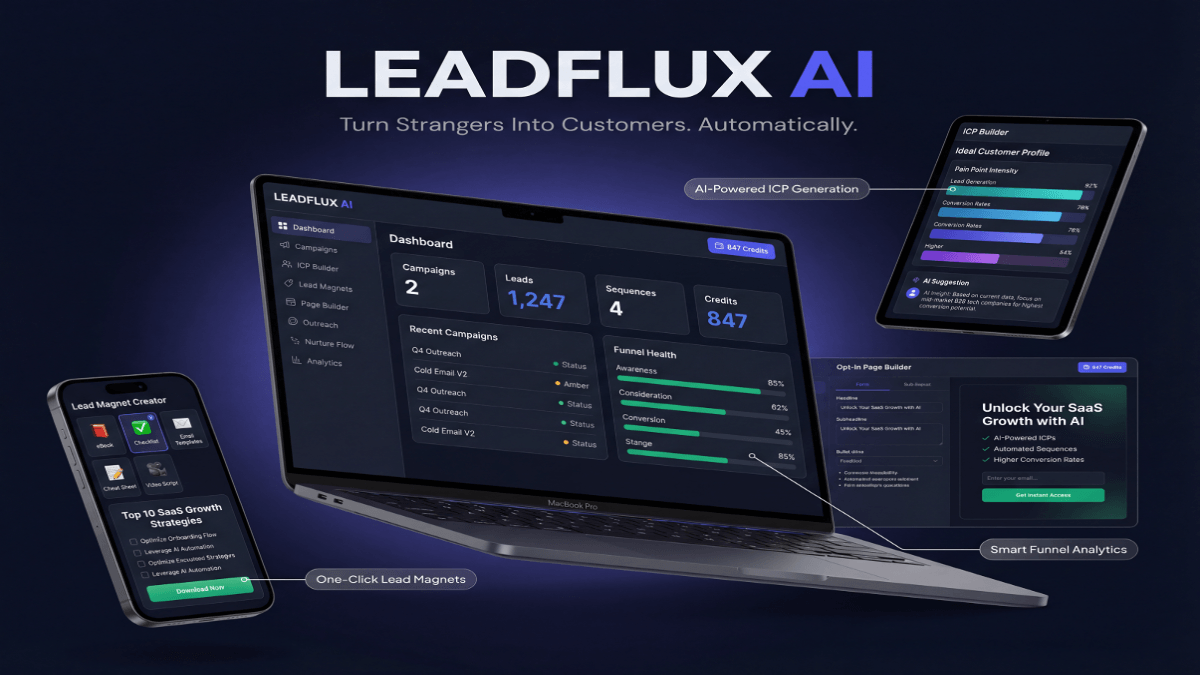
Stop Guessing. Start Converting.
LeadFlux AI Does the Heavy Lifting.
Tracking KPIs is only half the battle — you need a system that turns data into revenue. LeadFlux AI automatically identifies your highest-value prospects, scores leads in real time, and delivers conversion-ready pipelines so you can focus on closing deals, not chasing dead ends.
See How LeadFlux AI WorksCreate segments in your email platform based on scroll depth at conversion. Deep scrollers (70%+) are highly engaged prospects who’ve consumed significant content. They’ve self-qualified by investing time. Your welcome sequence for this group should assume knowledge and move quickly to advanced tactics or product demos.
Shallow scrollers (below 40%) need more nurturing. They raised their hand early, but they haven’t experienced the full value of your content. Your welcome sequence should deliver the insights they missed, gradually building trust before asking for a purchase or demo.
Mid-depth converters (40–70%) fall in between. They’ve engaged enough to understand your value but might need specific objections addressed or use cases clarified. Tailor your nurture sequence to bridge that gap.
Track which segment produces the highest lifetime value. In my experience, deep scrollers convert to paying customers at 2–3x the rate of shallow scrollers, but shallow scrollers who receive proper nurture sequences catch up within 60–90 days. The key is recognizing the difference and adapting your follow-up accordingly.
Testing Content Variations Against Scroll Benchmarks
Once you establish scroll depth baselines for your best-performing content, you can test variations scientifically. Your baseline might be: 70% reach 25%, 50% reach 50%, 30% reach 75%, 18% reach 100%. Any new post or content update should be measured against these benchmarks.
Test one variable at a time. Rewrite your introduction and measure scroll depth changes. If more readers reach the 50% mark, your new intro worked. If drop-off increased, you weakened the hook. Test section order—does moving your case study from 60% to 40% improve overall scroll depth and conversions?
I ran a test where we moved a comparison table from the 70% position to the 35% position. Scroll depth to 50% increased from 48% to 61%, and conversions on the embedded form at 55% jumped by 43%. The table pulled readers deeper because it delivered specific, scannable value early enough to hook them.
| Scroll Depth Milestone | Before Optimization | After Optimization | Impact on Conversions |
|---|---|---|---|
| 25% reached | 68% | 72% | +6% |
| 50% reached | 42% | 58% | +38% |
| 75% reached | 24% | 35% | +46% |
| 100% reached | 12% | 19% | +58% |
Test visual elements too. Adding a simple chart or screenshot at the 40% mark can stop the scroll bleed that happens when readers hit a wall of text. Subheadings matter—specific, benefit-driven H3s pull readers through better than generic labels.
Document what works and what doesn’t. Build a playbook of scroll-optimized patterns you can replicate across new content. Your goal is making every new post perform at or above your benchmarks from day one.
Turning Scroll Insights Into a Repeatable Content System
The real value of scroll depth tracking isn’t optimizing individual posts—it’s building a systematic approach to content creation that generates leads predictably. Once you know your high-converting scroll patterns, you can engineer them into your content briefs and writing process.
Start by creating content templates based on your best-performing structures. If posts with a framework section at 40%, a case study at 60%, and a comparison at 75% consistently drive deep engagement, make that your standard structure for tactics posts. Templates don’t make content generic—they ensure you include the elements that work.
Build scroll checkpoints into your editing process. Before publishing, ask: Does this post have a compelling hook in the first 10%? Do we deliver our first tactical insight by the 30% mark? Is there a momentum-builder at 60% to pull readers to the finish? Does the 70–80% section justify our strongest CTA?
Create a scroll depth dashboard that tracks performance across your entire content library. Monitor which topics, which formats, and which